
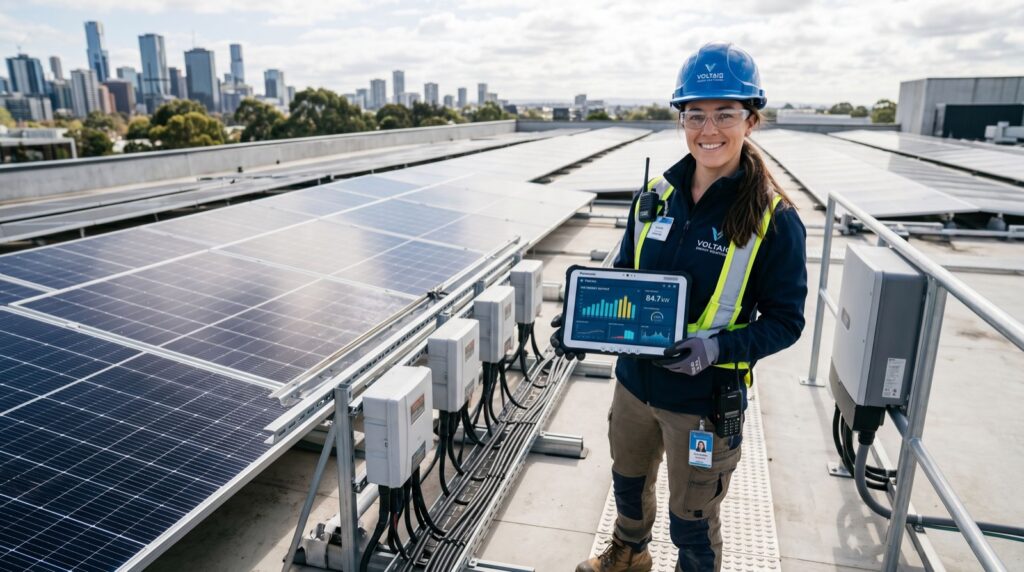
Choosing solar panels in Rawalpindi in 2026 has become confusing, because showrooms stack dozens of brands, wattages, and cell types side by side. This guide cuts through the jargon so you can pick panels that actually suit the twin cities’ climate and your rooftop.
Understanding solar panels in Rawalpindi’s climate
Rawalpindi delivers abundant sunshine, but it also brings scorching summer heat, dusty pre-monsoon winds, and humid spells. Panels behave differently under these conditions, so the “best” panel on paper is not always the best on your roof.
Heat is the hidden enemy. Every solar cell loses a little output as temperature climbs, measured by a spec called the temperature coefficient. In a hot city, a panel with a low coefficient quietly outproduces a rival with a higher headline wattage.
Dust is the second factor. Fine particles settle on the glass and block light, so panels with anti-reflective, easy-clean coatings hold their output longer between washes. The U.S. Department of Energy explains how cell design and glass treatment influence real-world yield.
Which panel technology fits your roof?
Three cell technologies dominate the 2026 market, and each carries trade-offs worth understanding before you buy.
- Monocrystalline PERC: The mainstream choice, offering high efficiency and reliable performance in heat.
- TOPCon: A newer, higher-efficiency cell with better low-light and temperature behavior, now widely available.
- Bifacial: Captures reflected light from the rear too, ideal for elevated or ground mounts with bright surfaces below.
Efficiency versus roof space
If your roof is generous, standard high-quality panels do the job affordably. If space is tight, higher-efficiency TOPCon modules squeeze more kilowatts into the same area, which matters for compact urban homes in Rawalpindi.
How do you compare panels fairly?
Wattage alone is a poor comparison tool. Two 580W panels can perform very differently once heat, warranty, and degradation enter the picture. Use the specs below to compare like with like.
| Spec | What It Means | Good 2026 Target |
|---|---|---|
| Efficiency | Power per square meter | 21% or higher |
| Temp coefficient | Loss per degree of heat | Closer to -0.30%/C |
| Degradation | Yearly output decline | Under 0.5% per year |
| Product warranty | Physical defect cover | 12 years or more |
| Performance warranty | Guaranteed output at year 25 | Above 84% |
Armed with this table, you can walk into any showroom and ask precise questions. Salespeople respect an informed buyer, and vague answers instantly reveal weaker products.
Matching panels to inverters and structure
Panels never work alone. The inverter must accept the panel’s voltage and current within its operating window, and the mounting structure must hold the panels at an angle that harvests Rawalpindi’s sun efficiently.
A tilt around 30 degrees facing south captures the most annual energy in this latitude. Good installers of solar panels in Rawalpindi calculate this precisely rather than laying modules flat, which can cost you several percent of yearly output.
Why brand consistency matters
Mixing mismatched panels on one string drags the whole string down to the weakest module’s level. Keep each string uniform in brand, wattage, and age. This single discipline preserves performance and simplifies future warranty claims.
How dust and heat quietly steal your output
Two forces work against every rooftop in northern Pakistan, and understanding them helps you choose panels that fight back. The first is soiling, the technical term for dust buildup on the glass.
In a dusty pre-monsoon month, an uncleaned panel can lose five to fifteen percent of its output. Panels with hydrophobic, anti-soiling glass shed dirt more easily and hold performance longer between cleanings, which matters in a city as dusty as Rawalpindi.
The second force is heat derating. Cell temperature on a summer afternoon can climb well above the ambient air, and each degree trims output. This is precisely why the temperature coefficient deserves as much attention as the headline wattage. A cooler-running panel simply generates more usable energy across the year.
The value of a live monitoring app
Modern inverters pair with apps that show generation panel by panel or string by string. This visibility is the practical antidote to hidden losses, because a shaded or failing module reveals itself as a dip on the chart. Treat monitoring as a standard feature, not a luxury add-on.
Warranty math you should run before buying
Panel warranties come in two flavors, and both deserve a quick calculation. The product warranty covers physical defects, while the performance warranty guarantees a minimum output percentage after 25 years.
Run the numbers. A panel guaranteed to hold 84 percent at year 25 will comfortably outproduce one that promises only 80 percent, and over a quarter century that difference adds up to real rupees. Longer product warranties also signal that the manufacturer trusts its own build quality.
Regional buying: does city choice change panel selection?
The physics of heat and dust apply across northern Pakistan, so the panel qualities that suit Rawalpindi also serve neighboring regions well. What shifts is logistics and service reach.
Buyers arranging solar installation in Peshawar, for instance, face similar heat and dust challenges and benefit from the same low temperature-coefficient panels. The smart move anywhere is to prioritize proven modules with strong local warranty support over unfamiliar bargain brands.
Working with trusted professionals keeps you clear of counterfeit modules, which unfortunately circulate in the market and fail years before their promised lifespan.
A quick buying sequence for panels
- Calculate your target system size from your monthly units.
- Measure usable, shade-free roof area to see if efficiency premiums are needed.
- Shortlist two or three Tier-1 panel models and compare their full spec sheets.
- Confirm the chosen inverter matches the panel’s voltage window.
- Verify serial numbers on delivery to rule out counterfeits.
Frequently Asked Questions
Are more expensive panels always better?
Not always, but the cheapest panels are rarely a bargain. Focus on efficiency, temperature coefficient, and warranty. A mid-to-premium Tier-1 module usually offers the best value over 25 years.
Do bifacial panels make sense for a home roof?
Only if the rear can catch reflected light, such as on a white terrace or elevated mount. On a standard dark rooftop the rear gain is small, so monofacial panels are often the sensible choice.
How do I spot counterfeit solar panels?
Verify the serial number against the manufacturer’s database, inspect the label and packaging quality, and buy only from installers who provide genuine datasheets. Prices far below market are a warning sign.
How much roof do I need for 10kW?
Roughly 45 to 55 square meters of shade-free area, depending on panel efficiency. Higher-efficiency TOPCon modules trim that footprint if your roof is small.
Should I wait for newer panel technology?
There is always a better panel around the corner, so waiting indefinitely means paying full grid tariffs in the meantime. Today’s Tier-1 TOPCon and PERC modules are mature, efficient, and well supported. The savings you capture now usually outweigh the marginal gains of next year’s models, so buy when your budget and roof are ready.
Pick panels that earn their place for decades
Choosing solar panels in Rawalpindi is about matching technology to your climate, roof, and budget, not chasing the biggest wattage number. Compare the full spec sheet, verify authenticity, and lean on experienced installers. Request a detailed panel proposal today and build a system designed to perform for 25 years.